Menu

Le Roi du Jardin
Gardens, parks and designed landscapes.
Historic gardens and parks that are worth the journey in themselves
Explore the collection- 261places
- 17Countries
- 150From source records
Bagnaia, Lazio — Ljuba brank · Wikimedia Commons · CC BY-SA 4.0
Provenance
This world opens with castles and estates whose Base Mérimée record mentions a garden. Gardens that exist as gardens — Villandry as a garden rather than as a castle — are not in the dataset yet. What follows is therefore what the source provides, not what the world will become.
01 — The collection
Gardens, parks and designed landscapes.
Gardens and parks worth visiting in their own right — including those attached to a castle that already appears in Le Roi du Château.

Rousham
Source recordCC-BY-SA-2.0

Royal Botanic Garden Edinburgh
The Royal Botanic Garden Edinburgh began near Holyrood Abbey in 1670 as a physic garden growing medicinal plants. The move to its present Inverleith setting began in 1820. The Edinburgh visitor collection includes the Rock Garden, Alpine Houses, Woodland Garden and Chinese Hillside, alongside rhododendrons and Scottish native plants in the Heath Garden.
Editorial selectionCC BY-SA 3.0
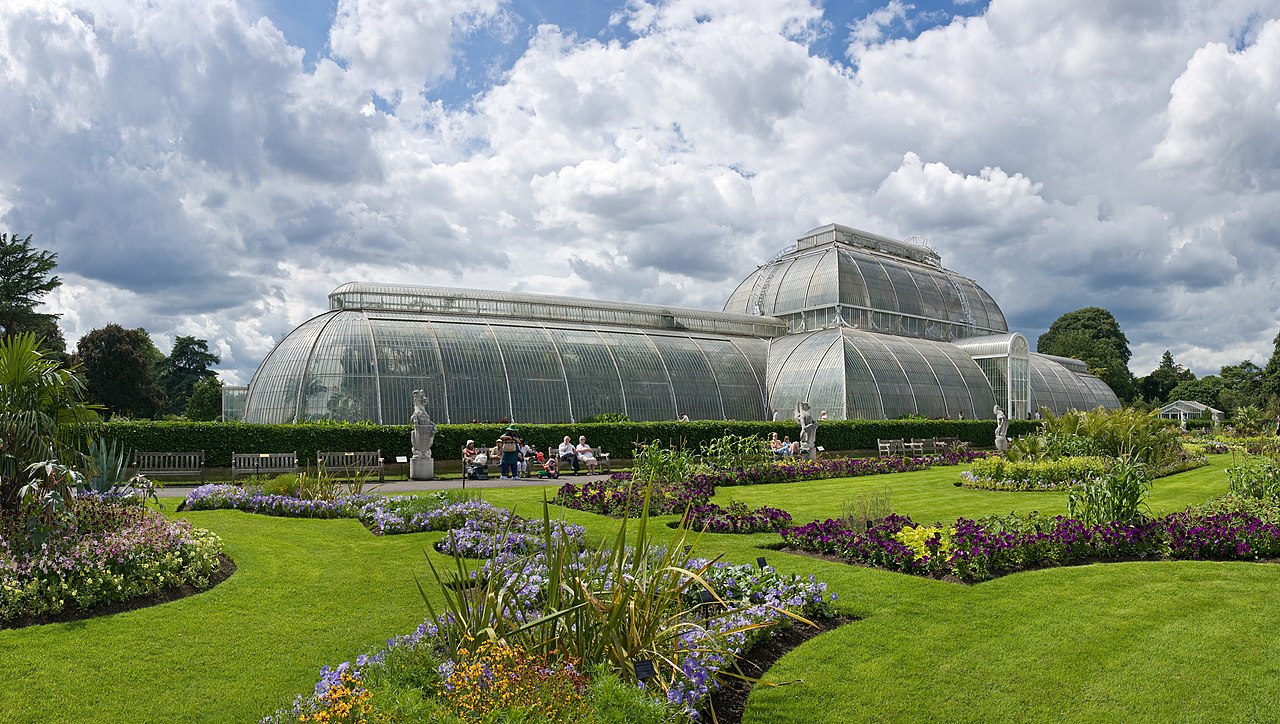
Royal Botanic Gardens, Kew
Editorial selectionCC BY-SA 3.0

Schloss Belvedere, Weimar
Belvedere Castle near Weimar was built for Duke Ernst August of Saxony-Weimar and Eisenach between 1724 and 1748. Originally a hunting lodge with a menagerie, it became a summer residence. In 1923 it entered the Weimar State Art Collections as a museum of eighteenth-century arts and crafts.
Editorial selectionCC BY-SA 3.0 de

Schloss Charlottenburg
Berlin
Schloss Charlottenburg is a château at Berlin, Berlin, in Germany. The recorded building campaign dates from the 18th century. Its architecture is recorded as Neoclassical architecture. The register records it as “cultural heritage ensemble”. Details are drawn from Wikidata.
Editorial selectionCC BY 4.0

Schloss Hellbrunn
Salzburg
Schloss Hellbrunn is a château at Salzburg, Salzburg, in Austria. The recorded building campaign dates from the 17th century. Its architecture is recorded as Baroque. The register records it as “Listed objects in Austria”. Details are drawn from Wikidata.
Editorial selectionCC BY 2.5

Schloss Mirabell
Salzburg
Schloss Mirabell is a château at Salzburg, Salzburg, in Austria. Its architecture is recorded as baroque architecture. The register records it as “Listed objects in Austria”. Details are drawn from Wikidata.
Editorial selectionCC BY-SA 3.0

Schloss Nymphenburg
Munich · Upper Bavaria
Schloss Nymphenburg is a château at Munich, in Germany. The recorded building campaign dates from the 17th century. Its architecture is recorded as baroque architecture. The register records it as “architectural heritage monument in Bavaria”. Details are drawn from Wikidata.
Editorial selectionCC BY-SA 4.0

Schloss Schönbrunn
Hietzing
Schloss Schönbrunn is a château at Hietzing, Vienna, in Austria. The recorded building campaign dates from the 17th century. Its architecture is recorded as Baroque. The register records it as “Listed objects in Austria”. Details are drawn from Wikidata.
Editorial selectionCC BY-SA 3.0 de

Schloss Veitshöchheim
Veitshöchheim · Lower Franconia
Schloss Veitshöchheim is a château at Veitshöchheim, in Germany. The recorded building campaign dates from the 18th century. Its architecture is recorded as baroque architecture. The register records it as “architectural heritage monument in Bavaria”. Details are drawn from Wikidata.
Editorial selectionCC BY-SA 3.0 de

Schloss Wilhelmshöhe
Kassel · Province of lower Hesse
Schloss Wilhelmshöhe is a château at Kassel, Hesse, in Germany. The recorded building campaign dates from the 18th century. Its architecture is recorded as Neoclassical architecture. The register records it as “Kulturdenkmal”. Details are drawn from Wikidata.
Editorial selectionCC BY-SA 4.0

Sissinghurst Castle
Editorial selectionCC BY-SA 3.0

St. Hanshaugen Park
St. Hanshaugen is Oslo’s oldest municipal park. The formerly bare hill was planted during the second half of the nineteenth century; the city records 1,275 trees planted in 1865. A drinking-water reservoir and the supervisor’s tower house were completed at the summit in 1875. The reflecting pool at the top dates from the 1960s. The park combines wooded slopes, lawns and water features with views towards the city and fjord. Its hilltop reaches about 83 metres above sea level.
Editorial selectionCC BY-SA 3.0

Stanley Park, Liverpool
Editorial selectionCC BY 3.0

Tøyen Park
Tøyen Park is a public green area in eastern Oslo, near the Botanical Garden and the rising ground of Ola Narr. Oslo municipality describes grassy slopes, paved uphill paths and natural lawn amphitheatres, with improving city views as visitors climb. Tøyenbadet is a separate facility within the wider park area. The municipal information identifies public transport approaches through Tøyen and nearby stops. This dossier concerns the open public park, not the separately managed Botanical Garden already represented in Jardin.
Editorial selectionCC BY-SA 3.0

Tromsø Arctic-Alpine Botanic Garden
Tromsø’s Arctic-Alpine Botanic Garden belongs to the university museum and cultivates plants from Arctic, alpine and other cold regions. Its constructed rock landscapes imitate mountain habitats, using large natural boulders with their lichen and moss surfaces retained. Collections include plants associated with the Arctic, the Himalaya and southern South America, alongside traditional northern Norwegian garden plants. UiT’s visitor page presents the garden as a seasonal outdoor attraction and provides current access and guided-tour information. Snow cover and flowering conditions strongly influence the experience.
Editorial selectionCC BY-SA 3.0

University of Agder Botanical Garden
The University of Agder’s Natural History Museum and Botanical Garden is in Kristiansand. The university’s Garden Explorer describes a living collection of approximately 2,000 plant species, used for research, conservation, teaching and public outreach. Visitors can search plant records, consult an interactive garden map, follow themed routes and locate facilities through that service. The garden’s official visitor information states that the outdoor collection is open throughout the year, including around the clock. Museum exhibitions and facilities should be checked separately.
Editorial selectionCC BY-SA 4.0

Vieux-Deffend
Montravers · Deux-Sèvres
Vieux-Deffend is a manor house at Montravers, Deux-Sèvres, in the Nouvelle-Aquitaine region of France. The recorded building campaign dates from the 16th century. It is protected as a monument historique at the second level (inscrit). Details are drawn from the Base Mérimée of the French Ministry of Culture.
Source recordCC BY-SA 4.0

Villa dei Vescovi
Torreglia
Villa dei Vescovi is a château at Torreglia, Veneto, in Italy. The recorded building campaign dates from the 15th century. Its architecture is recorded as Renaissance architecture. The register records it as “national monument of Italy”. Details are drawn from Wikidata.
Editorial selectionCC BY-SA 3.0

Weston Park
Editorial selectionCC BY-SA 4.0

Wrest Park
Source recordCC-BY-SA-2.0